
I was reading the LSD book, aka, Leadership and Self deception, and started writing a mini summary.
I like the take the authors have that seeing other people up your life as a means to an end is not good, but their approaches to fixing conflicts feel very uphill or one-sided. I agree looking inward seems that your ego gets in the way and that can get you in trouble for a variety of reasons . Anyway. Yes you can only change yourself and you cannot change other people but the ripple effect they describe feels slow.
Book in a few sentences
If you pay attention you’ll notice your relationships can be either inward or outward. In inward relationships, other people feel like objects in your life getting in the way of your goals, but when you relate to others outwardly, you are empathetic, seeing their wants and needs.
In order to see other people as having their own agency, with their own perspectives, the book suggests to follow your gut and reach out to other people authentically, instead of “holding back”, which they refer to as “self-betrayal”.
Often, two people can be stuck in a holding pattern, reacting to each other getting in each others way. The book calls this a kind of collusion. And the only way to break out of the holding pattern is to be vulnerable, and apologize to them for seeing them as an NPC.
There can be two varieties of inwardness: feeling better than or worse than others, and both can cloud your judgement. This cloud, the book refers to as self-deception.
And We use Justifications To rationalize the self-deception.
Some ddd vocabulary choices
I mostly like their vocabulary like self-deception for your biased subjective view of reality but the terms like self-betrayal for not going with your gut and collusion for two people stuck in a holding pattern of repeated offenses seem awkward.
But what if others are not acting in good faith
You can give others the benefit of the doubt but they might not be interested In having good faith conversations and then you end up the only one trying to do the right thing. If others act in pure self interest, while you try to cooperate, then you will go nowhere. This book kind of assumes that if you open up and become vulnerable, that others will follow in kind.
Maybe the idea is that regardless of the outcome, you still tried your best and that has its own psychological benefits too. For example, in the book, Tom reached out to Pierre, a former boss, and told them he wanted to apologize for not being more supportive in the past, but Pierre brushed him off. However, the next day, Pierre sent Tom an email reciprocating the vulnerability.
Some conflicts are resentments
Wounds from resentment that has festered, can take time to heal. There might be wrongs that people can feel need to be made right first. Sometimes only time heals wounds, as they say.
Vulnerability is harder if you’re starting from a position of weakness
I am finding that the stories in this book about successful adoption of the outward technique are so far about Lou, acting from a position of power. One was him apologizing to his son and another was him being vulnerable to his company former employees who quit so in both cases he could easily save face.
Also, when Tom was vulnerable, apologizing to Pierre, his former boss, who he wanted to see fail, he was calling him after he was already laid off from that company and so there was no longer any power dynamic between them and therefore had nothing to lose.
And the book is centered around a conflict between two managers who are peers, Ana and Tom, who need help to get along. They have a legitimate conflict which is laid out very nicely in the book, but they are at least, on an equal footing.
On the other hand, the more difficult cases are those where there are power asymmetries.
This is addressed at least once though, which is nice,
“We all exist in relationship,… We are who we are in relation to others, and they are who they are in relation to us, at least to some degree. So we can influence the dynamic between us.” (Theo, p151) “Not that we can force others to change, " Kate noted, “or that all relationships are on equal footing. Power differences exist. " (Kate, p 151)
Lou responds to the above, to say that just leading by example is also helpful,
“We don’t need to wait for others to change before we see their humanity. We can offer them a different, outward version of us to interact with, one that isn’t objectifying or blaming. And that can change the entire dynamic.” (Lou, p151)
, which of course is reminiscent of Mahatma Ghandi’s quote:
“We but mirror the world. All the tendencies present in the outer world are to be found in the world of our body. If we could change ourselves, the tendencies in the world would also change. As a man changes his own nature, so does the attitude of the world change towards him.”
or, “be the change you want to see happen”, as has been phrased later, (I’m reading this is attributed to Arleen Lorrance’s 1974 book The Love Project.)
Training together
And, page 146, goes more into Tom and Ana finally becoming vulnerable with each other. They do this, after receiving two days training together and I think that makes it much easier for them to fix their relationship, but clearly before, they could not simply do this organically.
They discuss collusion, together, empowered by Theo and Lou as guides.
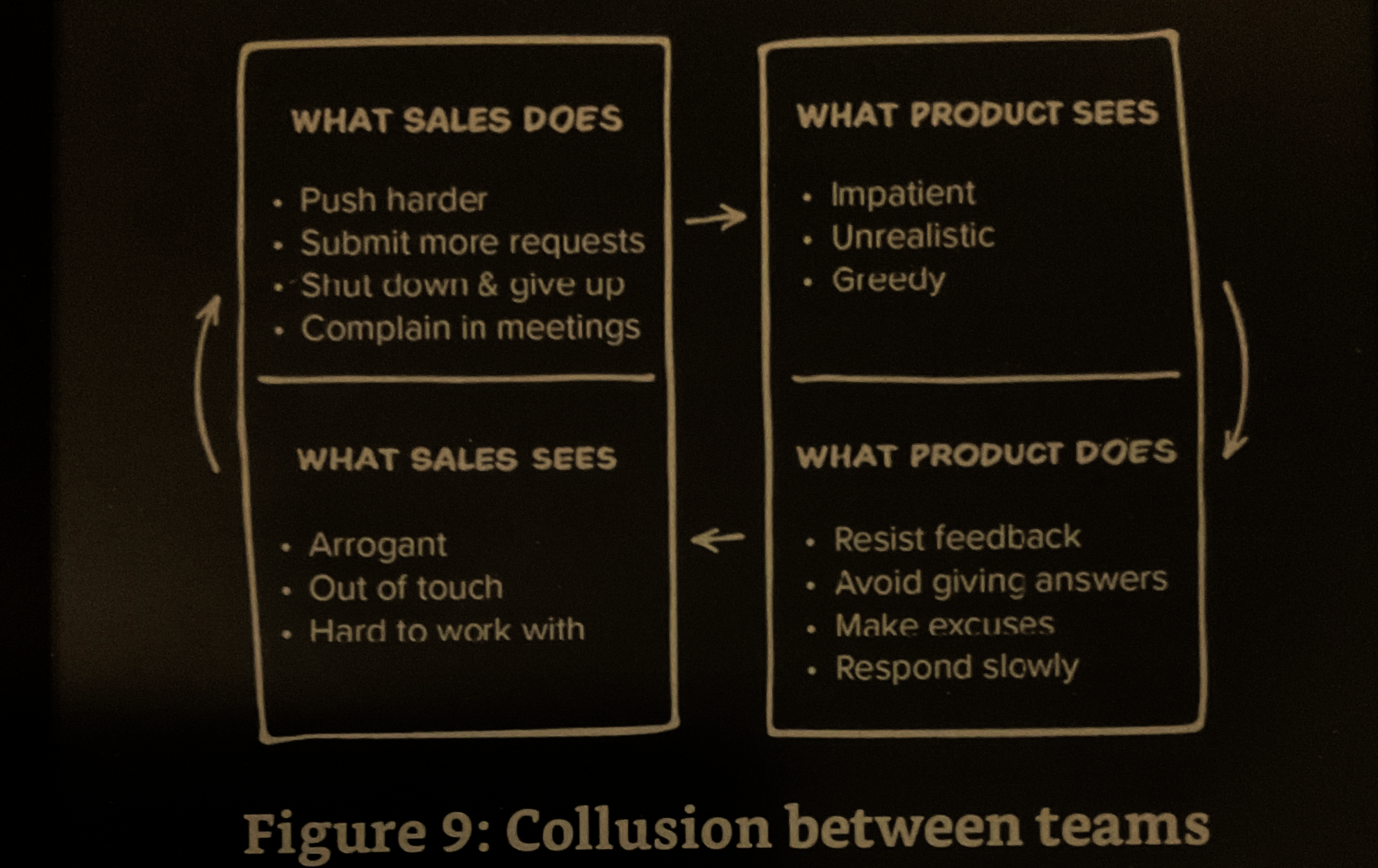
So since they are receiving the training together, they are well equipped to have the mending conversations together. They both know about being outward and avoiding self-deception.
On your own
Towards the end Lou or Theo say that if you try to cold open to someone who didnt get the self deception training , then you may in fact sound preachy and blamey. You will be perceived sounding like, “you simply dont understand that you are self deceived but I do.” ( around page 151).
“As you share what you’ve learned, remember that we can try to ’teach’ and that will just be a way to blame others with a new vocabulary.” (p151)
So I wonder if you really can only red pill another person you are in collusion with by giving them this book and hoping they download it into their mind too, or else you are kind of stuck on your own, fighting an up-hill battle.
Small talk is still hard
Sometimes you just need to break the ice. Being first takes courage. Until coworkers build rapport with each other, it will take them longer to resolve disagreements than otherwise. However, resolving real life conflicts, in situations that matter, can be really fruitful for building those bonds. So sometimes it just takes time.
Selected Quotes
1. workarounds
Page 33 | Highlight (Yellow) “I was less willing to share my thoughts because it seemed pointless,” Ana said. “And I tried to work around the person as much as I could.”
Until people are on the same page, and if they lack mutual empathy, they may often just try to work around each other. This is all too familiar.
2. benefit of the doubt
As I was reading, below, I realized that yes Tom is resentful to his wife for not taking her turn to check on their son, but I thought, hypothetically, maybe he did accurately detect the burden wasn’t being split fairly between them. It is well known that people are good at mental math when it comes to judging fairness. And then literally Ana asks something close to this in the session.
Page 47 | Highlight (Yellow) moment I was grudgingly looking after my son and resenting my wife. I was swallowing the very lie that I had created!”
Page 49 | Highlight (Yellow) “Well, what if Tracie had been pretending to be asleep? I mean, what if she was mad and wanted to punish you or something? Or what if your coworkers in San Francisco had been deliberately excluding you from the updates or food plans?”
Page 49 | Highlight (Yellow) “Ah,” Theo said, nodding. “I think you’re asking how we can know whether or not we’re seeing clearly. Are others intentionally mistreating us, or are we just perceiving mistreatment?”
Page 50 | Highlight (Yellow) “When we’re determining how much we trust someone or whether it is healthy for us to spend time with them, the kind of person they choose to be matters,” Theo said. “You don’t want to hire or get married to someone who is unkind or manipulative.
Page 50 | Highlight (Yellow) “The thing is,” Theo continued, “in the majority of interactions we have, we’re dealing with other human beings who are as imperfect as we are. But self-deception makes us more likely to see malevolent intent or animosity even when that isn’t the case. In fact, we’re likely to assume the worst if that gives us justification.”
So interestingly, Theo says two things. One, that, yes you’re not going to get along with everyone and that’s on you to figure out, which is basically the first chapter of No Rules Rules.
But also he says, hey why not give people the benefit of the doubt. I like that. It’s good to step back sometimes, and kind of like in Dan Ariely’s book Predictably Irrational, it can be detrimental to attempt to “keep tabs” or to “keep a dossier” of faults on people we are in relation with. It can become a fishing expedition where you might be cherry-picking data that works in your favor.
However, I was thinking in a more professional setting, you probably do want the receipts, but the data should be collected by an objective third party.
3. the fairness rationalization
Page 102 | Highlight (Yellow) “we use logic to accuse others and make excuses. The more plausible our blame and excuses are, the better they fuel self-deception. ‘I shouldn’t be expected to reach out and introduce myself. I’m the new hire around here!’ or ‘I can see that there’s an issue here, but addressing it isn’t in my job description.’ Or even ‘I’m not going to intervene; they need to learn the consequences of their actions.’ Page 103 | Highlight (Yellow) “Now, our excuses can be pretty sophisticated. We’ll claim that certain values like efficiency, or fairness, or common sense constrained our choice. We try to make our self-betrayal look rational, understandable, or even virtuous, as though placating a jury of our peers.”
The above is eye opening for sure. Rationalizations can sound super logical, but they are ultimately one-sided and subjective.
4. listening to your gut as self awareness
Page 103 | Highlight (Yellow) “But mostly, Tom, it just feels different. I know what it feels like to be defensive, and I know what it’s like to simply explain what happened. I know the difference between acknowledging what led to a mistake and dodging responsibility.”
This book is about mindfulness to a large extent. Though, interestingly they frame self awareness as simply “knowing” what to do which sounds to me like listening to your gut. In reality I think this is tricky and requires a lot of practice. This is much in the territory of meditation and or stoicism, which are not mentioned in this book, maybe because it is for a western audience.
5. some koolaid and win wins
Page 114 | Highlight (Yellow) looked right in my eyes. ‘Theo,’ he said, ‘I want to talk to you about that assignment. I know you are working hard, and you’re doing good work. I hope you know that.’ “‘But, when you take on an assignment, not following through has a ripple effect. People are depending on you delivering what you committed to do. If you know that you aren’t going to be able to keep a commitment, reach out, ask for help, let people know. We need you to be thinking about your impact on others.’” “How’d you take it?” Ana wondered. “Somehow I wasn’t offended or defensive. I was inspired. I found myself thanking him for talking to me.”
This is a good book, but it does have its share of koolaid drinking here and there haha. Too often, consistent overcommitment is built in to the system because adding slack instead can be perceived as laziness. This is a silly dark pattern most knowledge work is wrapped up in, but I would at least hope a fictional book with lots of positive messages could be more honest here.
When systems are built with adequate slack up front, there’s also breathing room for collaboration, and people can help unblock each other, very outwardly, as opposed to inwardly only focusing on their own tasks.
6. feedback
Page 155 | Highlight The conversation we just had wasn’t about Cheryl, Ana thought, finally surrendering to the truth. That was about me wanting to feel better about having misjudged her. But I didn’t tell her the truth about my earlier con-cerns. I stopped short. Just then the sound of the desk clock seemed louder than Ana re-membered. Tick. Tick. Tick. But I didn’t really stop short, right? Ana thought. I took responsibility. And taking responsibility is the main thing. The justifications were coming fast now. Cheryl pulled it together with that presentation, and bringing up anything before that would just be deflating. I need to keep her motivated, and I did apologize, and— The pattern was so predictable that Ana almost didn’t see it. But her exchange with Theo kept running in the back of her mind: “I don’t think they’re getting the real me,” she had said.
Ana stopped short of giving feedback to Cheryl, but she caught herself finally. And later she does try again.
Page 156 | Highlight “Having an outward mindset doesn’t mean overlooking others’ shortcomings. Lou didn’t let me off the hook for dropping my assignment, but he also didn’t reduce me to being my mistake. I was inspired to be better because Lou and I both knew I could be.”
Another echo to No Rules Rules here. A pro-feedback workplace is amazing, but most places are not able to pull it off.
Concluding Remarks
The mental reframing in this book is refreshing, but as I noted above, all parties involved need the same reprogramming / red-pilling, in order to begin seeing eye-to-eye. It is also maybe un-ironically pointed out in the book that trying to teach this book to others can be seen as another form of the “I-am-better-than-you” syndrome self-deception, it is trying to combat in the first place. And therefore, some kind of third party intervention seems unavoidable.
References
- https://arbinger.com/arbinger-resources
- Dan Ariely’s Predictably Irrational
- No Rules Rules
- Arleen Lorrance’s 1974 book The Love Project