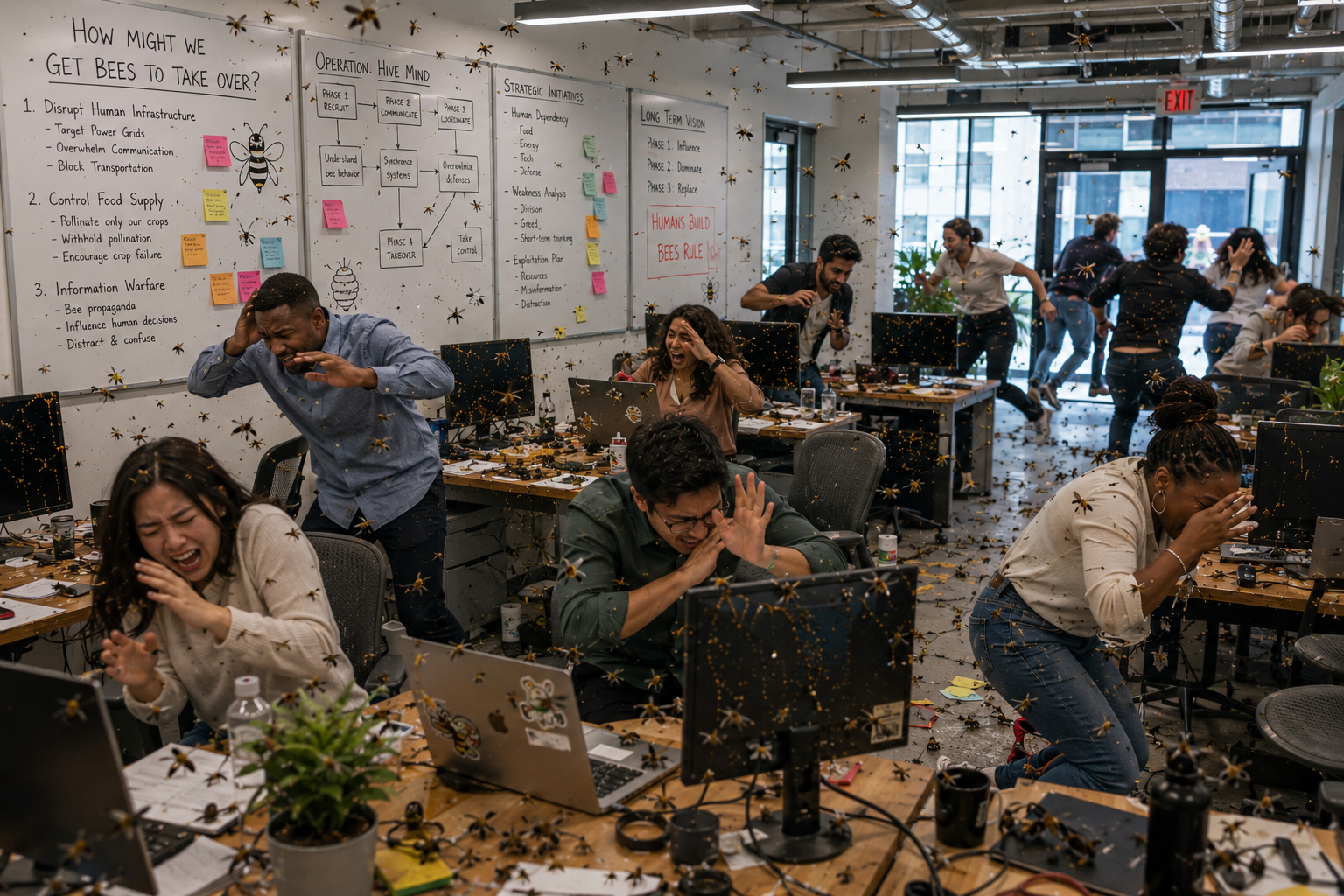
When I think of swarm, I think of bees or ants, preprogrammed by millenia of evolution. Each generation, following a script built into their bee-knees and ant-bdomens. Interestingly, survival of the fittest – a quote apparently a philosopher coined after reading Origin of Species but not Darwin himself wrote – maybe doesn’t mean the best particular colony carries on, but more like the particular gene line in a particular place on Earth – so Selfish Gene.
Agentic Swarms
In 2025 we have seen the industry go from vibe coding to agentic engineering. And now in 2026, there is a chatter about agentic swarming. I’m thinking of Steve Yegge’s Gas Town [11] orchestration, OpenAI highlighting Hebbia building agentic swarms on top of Codex [13] and other references to swarms on medium [1]. OpenAI used to have a github project, openai/swarm [2] which has been deprecated in favor of another project, openai/openai-agents-python[3].
But let’s jump back a hundred years or so.
Gantt Chart Fever
I didn’t realize Henry Gantt was Frederick Taylor’s associate!? In the 1910s, Taylor’s Scientific Management was about collecting a lot of data to optimize machine shop manufacturing. Sounds very reasonable. At one point, many decades later, this started getting applied to novel stuff?
In the 1950s-1960s, project management theory started trying to plan novel projects. Experts know best, right? Whinston W. Royce warned (1970) against waterfall software projects, but was misinterpreted. Kahneman/Tversky (1979) wrote planning fails without statistics. Agile manifesto (2001) underscored, you discover the work as you start doing it. We know they were responding directly to the church of process and planning that was quite common in enterprises. But their efforts were only coopted by the consulting industrial complex.
But now agentic engineering and swarming seems to be regressing to the project management waterfall style decomposition? Why would it work with bots if it didn’t work with humans?
Like Taylor wrote, stressing the science part, if you can collect the data, you can prove out adjustments to repeatable steps in a manufacturing process, reducing time and cost along the way.
Wikipedia notes [14] that Gantt intendded the chart to measure productivity of routine work, citing an interpretation here [15], comparing workers against distributions, as a way of giving feedback to workers. So this heavily involved data.
Tasks vs Asks
The 21st century brought distributed systems, a new category of programming, divide and conquer made a lot of sense. In fact, Map Reduce was one of the ways it started.
All told, the 2000s - 2010s brought us MapReduce, Hadoop, Spark, Kafka, Kubernetes, distributing well defined data tasks in fault tolerant systems.
This is also when data science became a thing. Now all kinds of tasks, that for decades used to be one off tasks done by people, were now made by ML algorithms: lending decisions, judicial sentencing and parole decisions, insurance adjustment decisions, medical insurance claims approval decisions, call center customer churn decisions, hiring and firing decisions, and many others.
And fast forwarding to 2024-2025 and today, we are seeing this transition from tasks to asks. Here, a task is routine, it is supported by lots of data, it is at thise point backed by data science. And asks start to be more open ended. With agentic programming, it’s let me add this feature or squash this bug with respect to my software system. Through RLVR Reinforcement Learning with Verifiable Rewards, there is good evidence that well defined asks can still lean towards being tasks. But as the prompts and specs become more open ended and when their solution space contains more paths, these are now asks and we start to regress to Kahneman and Tversky’s Planning Fallacy from 45 years ago.
More data
For now agentic swarming feels to fit right into the planning fallacy and we are also still not out of the woods of the agentic engineering slot machine, but who knows, maybe it is possible that we can collect enough data that even planning itself would collapse to being a solved problem. More likely, most innovation will not fit into this, but can still end up capturing a larger and larger surface for the routine. Then routine will be exciting 😅?
References
https://ai.plainenglish.io/openai-shocks-the-world-with-gpt-6-dc54b0db5d04
harvard business review, data science pin factory article
Agile Manifesto 2001
W. W. Royce 1970 Managing the development of large software systems : Concepts and techniques , https://scispace.com/papers/managing-the-development-of-large-software-systems-concepts-2fw8xjixsn
Kahneman, D., & Tversky, A. (1979). Intuitive prediction: Biases and corrective procedures. Management Science, 12, 313-327, https://kahneman.scholar.princeton.edu/publications
https://www.researchgate.net/publication/251449615_The_Planning_Fallacy
spark
kubernetes
Steve Yegge orchestration Gas Town blog posts
https://openai.com/index/hebbia/#tackling-complexity-with-agent-swarms
Geraldi, Joana; Lechter, Thomas (2012). “Gantt charts revisited”. International Journal of Managing Projects in Business. 5 (4): 578-594. https://doi.org/10.1108%2F17538371211268889